Resources
Graphics
Articles
Videos
We are pleased to offer a range of free resources for you to use. They can be downloaded by clicking the image or article title.
Graphics


Research articles by Group members (open access)
END-OF-LIFE DOULAS: INTERNATIONAL REFLECTIONS ON A TRANSNATIONAL MOVEMENT
Krawczyk, Marian, Emma Clare, Erin Collins, Sarah Farr, Elizabeth Johnson, Jennifer Mallmes, Annetta Mallon, Kelly Oberle and Jennifer Rigal. (2023) Palliative Care and Social Practice, 17, 26323524231186826.
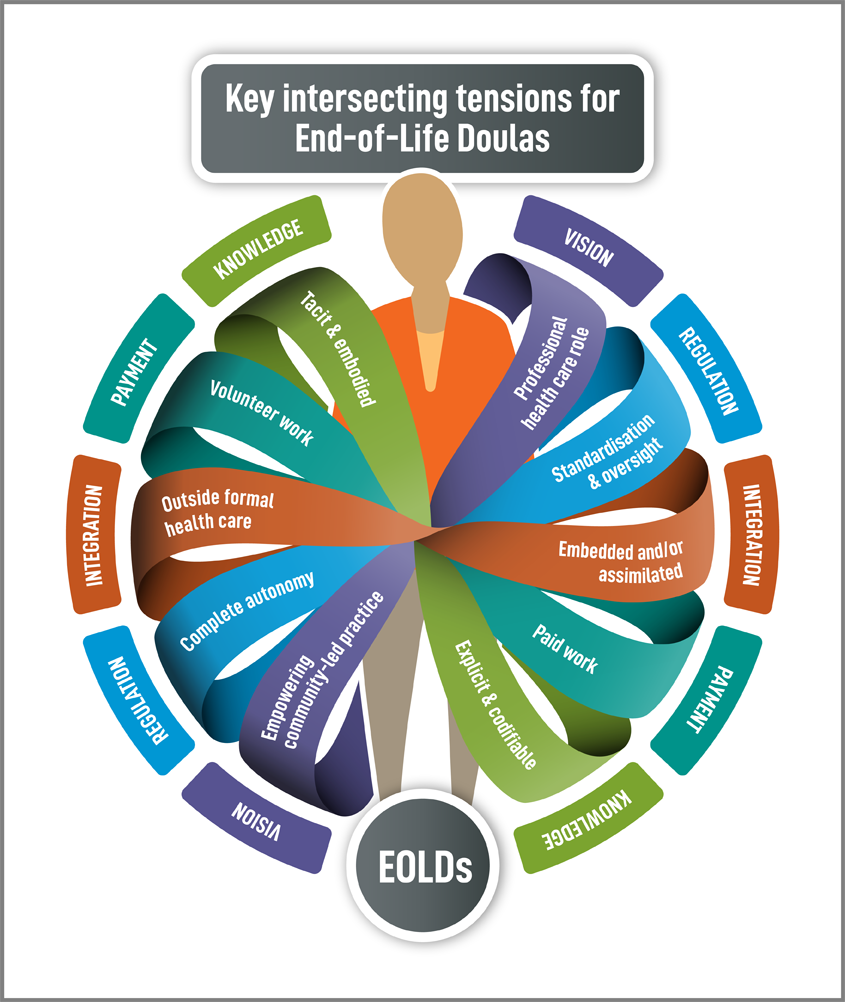
This review article summarizes the findings from the first virtual International End-of-Life Doula Symposium, held over 3 days on 25–27 April 2022. More than 40 people attended from seven countries, predominantly from Australia, Canada, the United States and the United Kingdom, and they were primarily experienced practitioners. In this article, we focus on participants’ topics of conversations and experiences that were relevant across international boundaries, organized through the symposium themes of developments, disruptions, dilemmas and directions. We provide a model for integration pathways within existing health care systems, as well as an innovative conceptual framework synthesizing key intersecting developmental issues that are relevant across regional and national boundaries. Our findings indicate that there are fundamentally similar developmental issues across countries, along with some variations. As the first international event of its kind, our ‘state of the field’ summary review of the symposium holds significant insights relevant to both national and international contexts, and to a diversity of stakeholders interested in the development of this new care role and emerging transnational movement.
COMPASSIONATE COMMUNITY STRUCTURE AND FUNCTION: A STANDARDISED MICRO-MODEL FOR END-OF-LIFE DOULAS AND COMMUNITY MEMBERS SUPPORTING THOSE WHO WISH TO DIE AT HOME
Mallon, A. (2021) Palliative Care and Social Practice, 15, 26323524211052569.
Background: End-of-life doulas are an emerging, non-medical support and advocacy role for the dying and their caregivers. As more and more people are dying at home, research shows end-of-life doulas are increasingly in demand as non-medical advocates and companions for the dying, and their friends and families. Compassionate communities are essential to those who wish to die at home by helping to avoid carer stress and burnout associated with physical and emotional labour when a person is at end of life. However, compassionate community models are top-down in nature as they focus on public policy, missing a domestic-scale, standardised design applicable when someone wishes to die at home. This gap affects care networks and communications and arguably hinders the work of end-of-life doulas. Aim: Findings from original qualitative research with end-of-life doulas in four countries demonstrated the importance of compassionate communities for death literacy and support for a person at end of life and their networks and that all practitioners were using ad hoc, variable approaches to compassionate community formation and maintenance. A micro-level standardised and replicable model for organising and maintaining compassionate communities for end-of-life doulas which completes the established compassionate community model was developed to fill this gap and provide a vital tool for end-of-life doulas and training programmes internationally. Methods: Thematic analysis of research data from qualitative semi-structured interviews with end-of-life doulas in four countries was undertaken and considered as a cohort as well as by country. Conclusions: A model was developed that addresses a gap in international approaches to practice, offering a standardised way to discuss, teach, and implement compassionate communities for end-of-life doulas in a variety of countries and languages. This article discusses the research and model in detail.
INDIGENOUS END-OF-LIFE DOULA COURSE: BRINGING THE CULTURE HOME
Gaspard, G., Gadsby, C., & Mallmes, J. (2021). International Journal of Indigenous Health, 16(2).
Many Indigenous people who live on their traditional territory die in hospital when their preference is to enter the spirit world from their home. Indigenous people in Canada describe experiencing many barriers that prevent them from making this final choice in life. The First Nations Health Authority in British Columbia (BC), Canada, in collaboration with Douglas College, offered end-of- life doula training classes to Indigenous people in BC in 2019. The goal was to build on the strengths of community members already supporting people and their families during their final journey into the spirit world. There were 86 participants (72% identified as Indigenous) from the five health regions in BC, representing 47 Indigenous communities. Participants were overwhelmingly satisfied with the five-day course and planned to take their new learnings back to their community. It was noted, however, that this course would benefit from adaptations, including a greater emphasis on traditional Indigenous practices, facilitation tips, and strategies to support people through loss and bereavement. Furthermore, the term “end-of-life doula” is sometimes associated with a for-profit business, which is counterintuitive to traditional Indigenous practices, highlighting the necessity for a name change. Further evaluation over the next year is necessary to confirm that the course makes a positive difference in the final journey for Indigenous people.
DESCRIBING THE END-OF-LIFE DOULA ROLE AND PRACTICES OF CARE: PERSPECTIVES FROM FOUR COUNTRIES
Krawczyk, M., & Rush, M. (2020). Palliative Care and Social Practice, 14, 2632352420973226.
Background: End-of-life doulas are emerging as a potentially important new form of community-based caregiving in the global North, yet we know little about this form of care. The aim of our study was to solicit the perspective of key stakeholders and early innovators in community-based end-of-life care about the development and practices of end-of-life doulas. Methods: We conducted 22 semi-structured interviews with participants in four countries where end-of-life doulas are most active: Australia, Canada, the United States, and the United Kingdom. Findings: This article focuses on participants’ description of the end-of-life doula role and attendant practices, and our findings provide the first detailed taxonomy of the end-of-life doula role and specific services on the basis of the perspective of subject experts in four countries. We situate our findings within literature on the professionalization of caregiving, with particular attention to nomenclature, role flexibility and boundary blurring, and explicit versus tacit knowledge. We also discuss the importance of jurisdictional considerations as the end-of-life doula movement develops. Discussion: We speculate that the end-of-life doula role is potentially experiencing common developmental antecedents similar to other now-professionalized forms of caregiving. Our findings contribute substantial new information to the small body of empirical research about the end-of-life doula role and practices, provide critical firsthand insight as the movement develops, and are the first research to explore end-of-life doulas from a comparative international perspective.
Video Presentations
See PAST EVENTS in menu or choose by Symposium year:
2024
2023
2022